Fast Voxelwise SNR Estimation for Iterative MRI Reconstructions
PICO uses random image-space probes to estimate voxelwise noise variance, SNR, and g-factor in iterative MRI reconstruction.
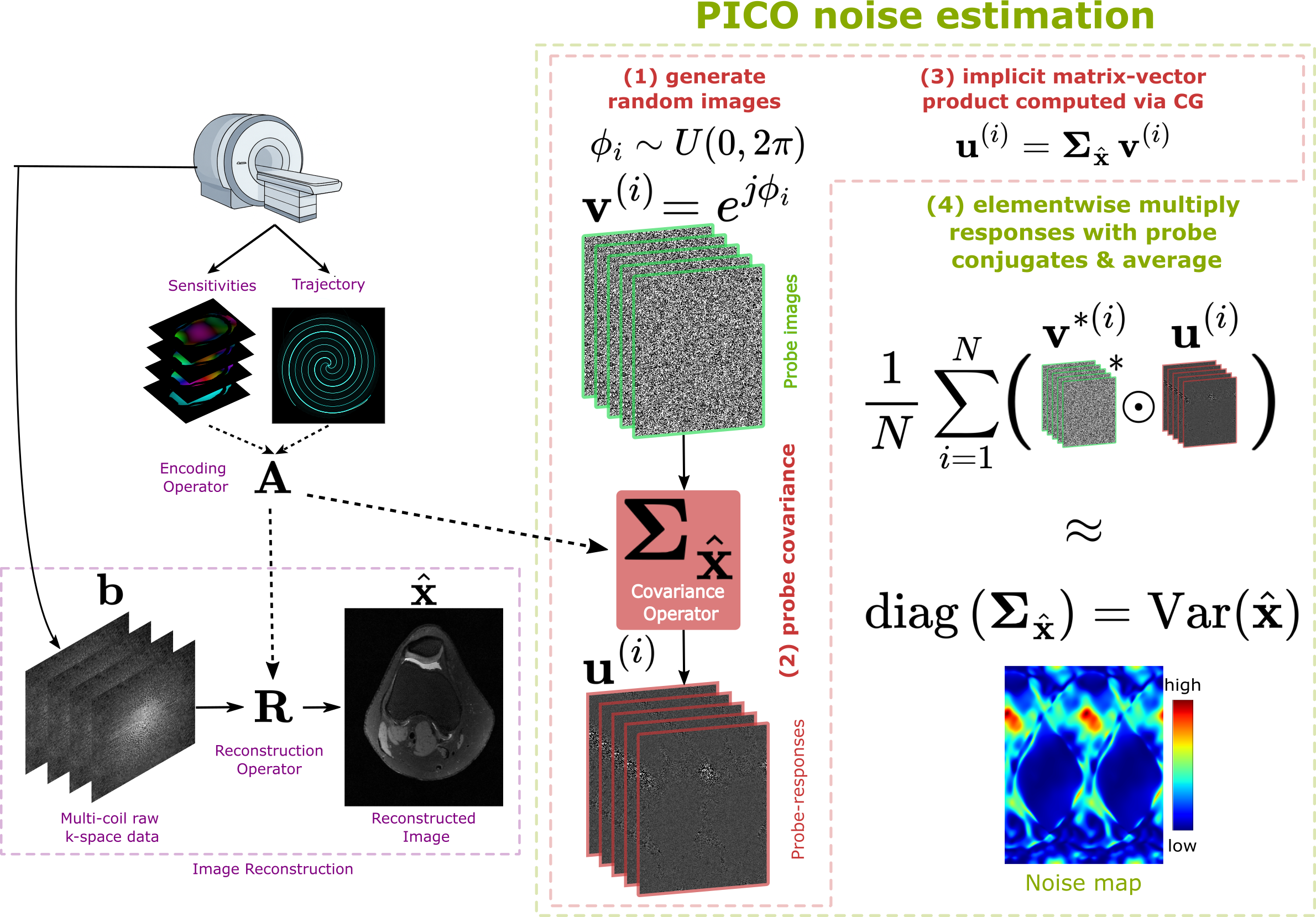
How PICO works
PICO (Probing Image-space COvariance) estimates the diagonal of the reconstructed image’s noise covariance. It applies the covariance operator to random-phase image probes, multiplies each response by the conjugate of its probe, and averages the products voxel by voxel. For linear reconstructions, this targets the full covariance diagonal. For nonlinear reconstructions, it targets a first-order approximation from the Jacobian at the reconstructed solution.
The paper evaluates Cartesian and non-Cartesian CG-SENSE and total-variation-regularized compressed sensing. SNR and g-factor are derived from the estimated variance. A fully sampled reference is needed for the g-factor comparison.
Cartesian knee example
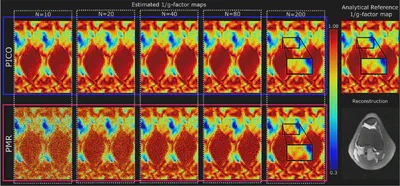
This example uses Cartesian CG-SENSE at R = 2. The figure compares PICO (top) and pseudo multiple replicas (bottom) at N = 10, 20, 40, 80, and 200 probes or replicas. PICO recovers the main spatial pattern at N = 10. The analytical SENSE reference appears at right. Figure 2 of the preprint documents this comparison.
Reproduce the experiments
The toolbox instructions list the environment setup and notebooks. Start with the Cartesian knee notebook for the figure above. The repository also provides notebooks for the spiral brain phantom and compressed-sensing knee experiments.