Efficient Noise Calculation in Deep Learning-based MRI Reconstructions
Randomized Jacobian sketches estimate voxelwise noise variance through deep MRI reconstruction networks.
How Jacobian sketching works
The estimator propagates random measurement-noise sketches through the Jacobian of a trained reconstruction network. Forward-mode Jacobian-vector products let it estimate the covariance diagonal in image space without materializing the full Jacobian. The target is the noise variance under a first-order approximation of the reconstruction about the input.
Knee MRI example
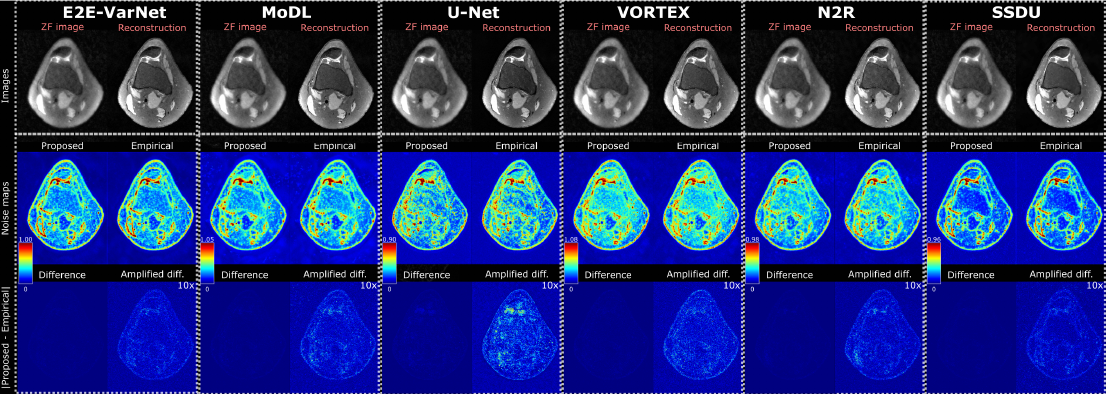
Figure 1 compares sketch-based voxelwise variance with a Monte Carlo reference across six reconstruction networks on knee data at acceleration R = 8 and noise scaling α = 1. The estimates reproduce the main spatial patterns. The difference maps show residual discrepancies near sharp intensity transitions.
Reproduce the experiments
The implementation includes model training and inference scripts and a Python example for computing noise maps. The paper describes the empirical noise reference in Section 4.1 and the models, training settings, and datasets in Appendix H. The arXiv version is also available.